Affordable housing projects require substantial funding for land, permits, design, construction, and infrastructure. Since lower rents limit how quickly developers can recover these costs, projects often depend on several financing sources. Affordable housing bonds are one of those tools, helping state and local agencies raise capital for homeownership programs and rental housing developments.
As construction methods continue to evolve, financing can also work alongside modern building approaches. At Azure Printed Homes, we build modular living spaces that are manufactured in a controlled factory environment before being delivered to the site. Because factory production and site preparation can move forward during the same general project timeline, developers may gain additional flexibility when planning affordable housing projects that depend on careful budgeting and scheduling.
This guide explains how affordable housing bonds work, who issues them, how they are repaid, and why they remain an important part of housing development.
What Affordable Housing Bonds Are
Affordable housing bonds are debt securities issued by state or local government entities to raise money for affordable housing programs. Instead of relying entirely on annual government budgets, housing agencies can borrow money from investors and use those funds to finance housing-related initiatives.
The money raised through these bonds may be used for purposes such as:
- Building affordable rental housing
- Rehabilitating existing housing
- Supporting multifamily developments
- Financing mortgages for eligible homebuyers
- Preserving affordable housing communities
After the bonds are issued, investors purchase them. The issuing agency then repays investors over time according to the bond’s terms. Housing bonds are commonly issued through state or local Housing Finance Agencies (HFAs), which coordinate financing programs intended to increase the supply of affordable housing.
The Role of Affordable Housing Bonds
Developing housing is expensive. Construction costs, land prices, infrastructure, labor, permitting, and financing all contribute to the total project budget.
Affordable housing developments face an additional challenge. Since rents or purchase prices are intentionally kept below market levels for qualifying households, projects often generate less revenue than market-rate developments. That can make securing traditional financing more difficult.
Affordable housing bonds help bridge that gap by providing access to financing that supports long-term housing goals. Rather than replacing private investment, bonds usually become one part of a broader financial structure that may also include tax credits, grants, loans, equity investments, and other public or private funding sources.
How Affordable Housing Bonds Work
Although individual programs vary, the overall process generally follows several steps.
Step 1: A Housing Agency Issues Bonds
A state or local housing agency determines that financing is needed for affordable housing programs or specific developments. Instead of using existing public funds, the agency issues bonds to investors. The sale of those bonds generates capital that can be directed toward qualifying housing activities.
Step 2: Investors Purchase the Bonds
Institutional investors, banks, investment funds, and other purchasers buy the bonds. In return, investors receive scheduled interest payments and repayment of the principal according to the bond’s terms. Many housing bonds are municipal bonds, which may receive favorable tax treatment under applicable federal and state tax laws.
Step 3: Financing Supports Housing Projects
The proceeds from bond sales are then used to finance qualifying housing activities. Depending on the program, funding may support:
- New affordable housing construction
- Property rehabilitation
- Mortgage lending
- Preservation of existing affordable housing
- Multifamily residential developments
The exact eligibility requirements depend on the issuing program and jurisdiction.
Step 4: Revenue Supports Repayment
Housing bonds are commonly structured as revenue bonds. Rather than relying directly on general tax revenues, repayment often comes from revenue generated by the financed programs, such as mortgage payments, loan repayments, or rental income associated with the housing development. This structure helps connect project performance with long-term financing.
Types of Affordable Housing Bonds and Their Uses
Affordable housing bonds can support both homeownership programs and rental housing developments. The structure depends on who issues the bond, how it will be repaid, and what type of housing the financing is intended to support.
Revenue Bonds and General Obligation Bonds
Most housing bonds are structured as revenue bonds. These are repaid using income connected to the financed housing program or development, such as mortgage payments, loan repayments, rental income, or other project revenue.
General obligation bonds work differently. They are backed by the issuing government’s broader financial resources and taxing authority rather than the income of a specific housing project. Affordable housing programs more often rely on revenue bond structures because repayment is tied directly to the financed activity.
Mortgage Revenue Bonds
Mortgage Revenue Bonds help housing agencies provide financing to eligible homebuyers through participating lenders. Qualification rules may consider:
- Household income
- Home purchase price
- Property eligibility
- First-time homebuyer status
Exact requirements vary by state and program, but the overall goal is to expand access to mortgage financing for households that meet local eligibility standards.
Bonds for Multifamily Housing
Affordable housing bonds can also finance the construction, acquisition, or rehabilitation of multifamily properties, including apartment communities, senior housing, workforce housing, mixed-income developments, and permanent supportive housing.
These bonds are often combined with tax credits, loans, grants, and private investment. Each source covers a different part of the project budget, helping developers manage construction costs while maintaining long-term affordability.
Securing financing is only one part of the process. The construction method also affects timelines, labor needs, site coordination, and overall project costs. Modular construction can give affordable housing developers a more controlled path from funding to completion.
How Modular Construction Supports Affordable Housing
Affordable housing financing focuses on making projects financially achievable, but construction methods also influence project outcomes. Factory-built modular construction offers several characteristics that may support affordable housing development.
More Predictable Manufacturing
Affordable housing projects often involve tight budgets and financing deadlines, so unexpected delays can create problems beyond the construction site. Weather, labor shortages, and changing site conditions can all affect a traditional build.
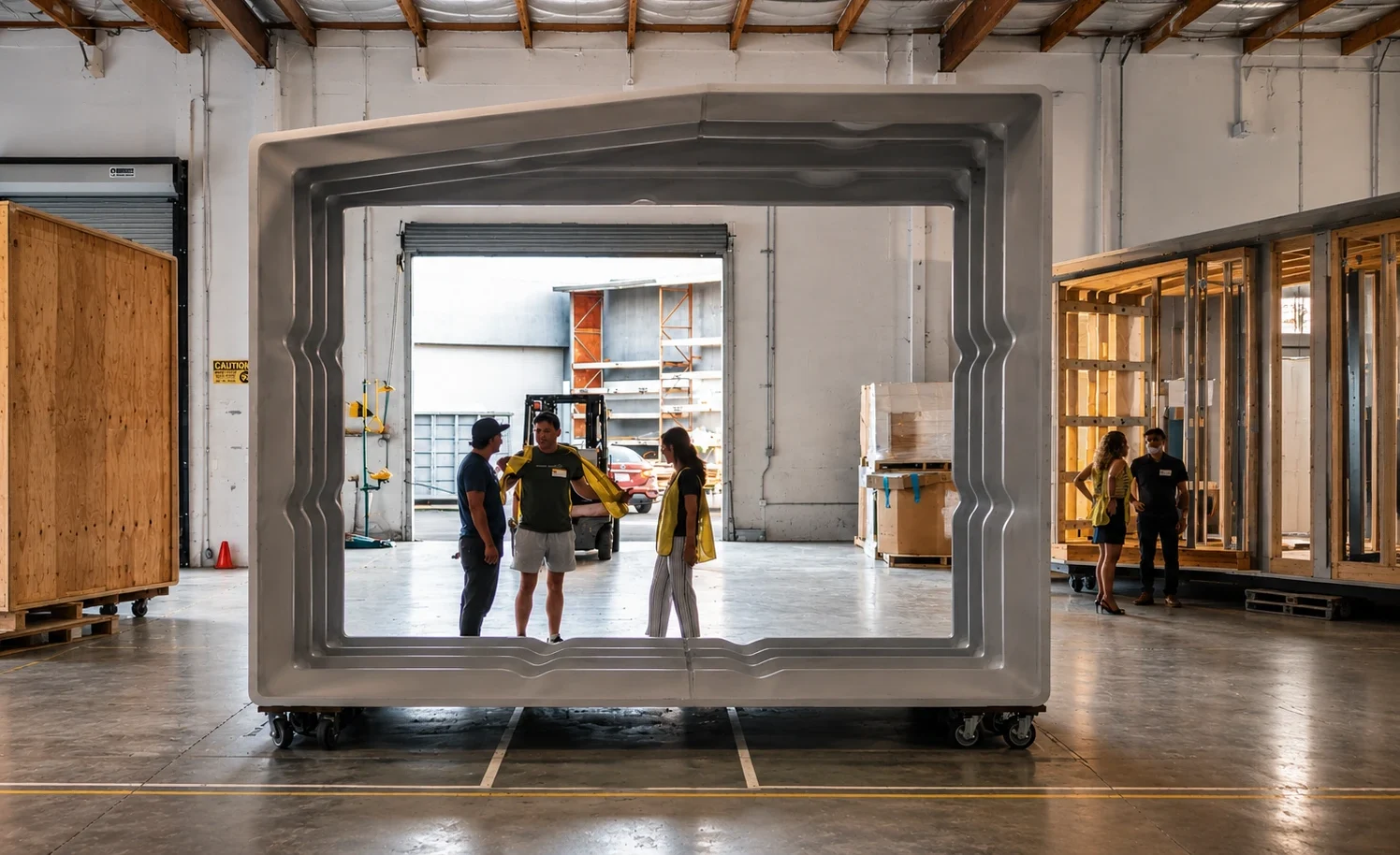
By manufacturing units in a controlled factory environment, we can complete major stages of production under more consistent conditions. Robotic printing, automated fabrication, and planned assembly help create a steadier workflow, while electrical, plumbing, mechanical systems, and interior finishes can be installed before delivery. This gives project teams a clearer view of how the building is progressing and reduces dependence on daily site conditions.
Parallel Construction Activities
Traditional construction usually moves through a long sequence of site-based stages. Foundations, framing, utilities, finishes, and inspections often depend on the previous phase being completed first.
Modular construction allows several parts of the project to move forward at the same time. While our team manufactures the units in the factory, the developer can coordinate grading, foundations, utility preparation, drainage, and other site work. Once both sides are ready, the units can be delivered and installed. This overlap can reduce idle time between major construction phases and help projects move from financing to occupancy more efficiently.
Flexible Housing Options
Affordable housing projects rarely have identical needs. A small infill property may require a compact one-bedroom home, while a larger site may need multiple layouts for households of different sizes.
We offer a range of homes and ADUs in different sizes and layouts to support varied household needs and project goals. Standard models can be configured with different bedroom arrangements, while custom modular designs allow further changes to dimensions, layouts, finishes, and features when a project requires a more tailored solution.
Better Cost Visibility
Affordable housing financing often combines bonds, tax credits, loans, grants, and private investment. With several funding sources involved, developers need a realistic understanding of what the construction price includes and which costs remain separate.
Our factory pricing includes electrical, mechanical, plumbing, and interior finishes. Site work, foundations, permit fees, utility connections, and delivery are handled separately because they depend on the location and project conditions. Separating these categories helps developers identify which parts of the budget relate to the factory-built unit and which must be planned at the property level.
Reduced Material Waste
Construction waste can increase disposal costs and make it harder for projects to meet sustainability goals. Factory production offers more control over how materials are measured, cut, reused, and incorporated into each unit.
Our robotically printed products use recycled plastic materials, with approximately 100,000 plastic bottles repurposed for every 120 sq ft of printed space. The printing process places material according to the digital model rather than cutting large quantities of conventional material on site. This approach supports more precise material use while giving discarded plastic a new purpose in long-lasting building components.
Energy-Efficient Building Envelopes
Long-term affordability depends on more than the initial construction cost. Energy use, maintenance, moisture control, and indoor comfort all affect what residents and property operators pay over time.
Our units are designed with insulated building envelopes, double-pane windows, and heating and cooling systems selected according to unit size and climate. The one-piece printed wall, roof, and floor assemblies used in some models also reduce the number of joints where water intrusion can occur. Solar panels, battery storage, and heated floors may be added where they suit the project, helping developers plan around local energy goals and resident needs.
Modular Housing Options for Affordable Housing Projects
Affordable housing projects can range from compact infill developments to larger residential communities. The right modular option depends on the intended residents, available space, local requirements, and the project’s overall budget.
| Product group | Models | Size range | Typical use | Starting price range |
| Studio Series | N100, A120, D120 | 100-120 sq ft | Compact support spaces, offices, guest rooms, community uses, or other small-footprint applications | $24,900-$29,900 |
| Homes and ADUs | A-360, A-540, A-720, A-900 | 360-900 sq ft | Complete residential units for individuals, couples, and small families | $89,900-$219,900 |
| Custom Modular Solutions | Custom configurations | Project-specific | Larger developments, unusual sites, adjusted layouts, and specialized project needs | Quoted individually |
Our Studio Series is suited to compact applications where a full residential layout may not be necessary. Homes and ADUs include kitchens, bathrooms, and bedroom layouts, making them a better fit for independent housing. For projects that do not match a standard model, we can also develop custom modular solutions with project-specific dimensions, layouts, finishes, and features.
Common Misunderstandings About Affordable Housing Bonds
Affordable housing bonds can support construction, but they do not remove the need for careful project planning. Developers still need a complete financing structure, a suitable building approach, and a realistic path from approval to occupancy.
They Are Not Grants
Bond financing provides borrowed capital that must be repaid according to the bond agreement. Unlike a grant, it does not eliminate the cost of development.
That makes construction efficiency important. A project using bond proceeds still needs to control spending, coordinate site work, and reduce avoidable delays. Modular construction can help by shifting much of the building process into a controlled factory environment, where materials, labor, and production stages are easier to organize.
They Are Not Only for Government Housing
Affordable housing bonds may support projects developed by nonprofit organizations, private developers, public agencies, or partnerships that meet the relevant program requirements.
The construction method can vary as well. Modular housing may be used for compact infill projects, ADU programs, small residential communities, or larger developments. We offer studios, homes and ADUs, and custom modular solutions that can be adapted to different project scales and resident needs.
Bonds Alone Rarely Finance an Entire Project
Housing bonds are usually one part of a broader financing package. Developers may also rely on tax credits, loans, grants, equity investment, or other funding sources.
Because each source may cover a different part of the development, the budget should distinguish the building cost from property-specific expenses. Our factory pricing provides a defined starting point for the modular unit, while foundations, permits, delivery, utilities, and site preparation are calculated according to the location and project conditions.
What Developers Consider Before Using Housing Bond Financing
Bond financing can provide an important source of capital, but developers need to evaluate how the financing structure and construction process will work together.
Eligibility Requirements
Projects must satisfy the rules of the specific bond program. These requirements may cover:
- Project purpose
- Income restrictions
- Affordability commitments
- Property type
- Regulatory compliance
The selected housing product must also suit the approved use. For example, a complete residential unit requires a different layout, permitting path, and utility plan than a compact studio or support space. Modular design decisions should therefore be made alongside the financing and compliance review.
Financing Structure
Bond financing rarely covers every project expense. Developers need to identify which costs are included in the factory-built unit and which remain tied to the property.
Modular construction can give developers a clearer basis for estimating the building portion of the budget early in the planning process. This helps project teams match bond proceeds and other funding sources to defined development stages while leaving room for location-specific costs.
Project Schedule
Bond-financed developments may include deadlines for approvals, construction starts, fund use, completion, and occupancy. Delays can affect carrying costs and coordination with lenders, investors, and public agencies.
We manufacture modular units while site preparation can move forward separately. A unit may be robotically printed in as little as one day before electrical work, plumbing, mechanical systems, and finishes are completed in the factory. This parallel workflow can reduce the amount of time spent waiting for one construction phase to finish before another begins.
Product and Layout Selection
Developers also need to match the housing type to the residents and the site. Smaller projects may need compact units, while family housing may require one- or two-bedroom layouts.
Our studio series covers compact 100-120 sq ft models, while homes and ADUs range from 360-900 sq ft. Custom modular projects can address needs that fall outside the standard lineup, including different dimensions, layouts, finishes, and building features.
Local Regulations and Site Conditions
Every jurisdiction has its own zoning, permitting, building, environmental, and installation requirements. The site may also require grading, drainage, utility upgrades, access planning, or a specific foundation system.
Modular construction does not bypass these requirements. Instead, it separates factory production from site work so both can be coordinated more clearly. Before production begins, developers should confirm that the selected model, intended use, transportation route, foundation, and utility plan comply with local rules.
Conclusion
Affordable housing bonds play an important role in financing housing that serves individuals and families with moderate and lower incomes. By allowing state and local housing agencies to raise capital through municipal bond markets, these programs help fund new construction, rehabilitation, mortgage lending, and long-term affordable housing initiatives.
For developers, understanding how housing bonds fit within a project’s broader financing strategy is just as important as selecting the right construction approach. Financing, permitting, design, manufacturing, and installation all influence the final outcome.
At Azure Printed Homes, we combine factory-based modular construction with robotically printed technology to support projects ranging from compact studios to larger homes & ADUs and custom residential developments. By manufacturing much of each unit before delivery and coordinating production with site preparation, we help create a more predictable building process that can align well with the planning requirements of affordable housing projects.