If you need emergency housing, start by calling 211 to reach local shelter and housing services, and call 911 if you are in immediate danger. After a declared disaster, apply for help from FEMA at DisasterAssistance.gov or by calling 1-800-621-3362, and contact your insurance company about temporary living costs. From there, local housing agencies and nonprofits can help you move from short-term shelter toward stable housing.
Where to go next depends on what happened. Fire or flood, eviction, an unsafe home and homelessness are each handled by different programs.
Immediate Steps to Take Today
- Get safe: if you or someone with you is in danger, call 911.
- Call 211: this free, confidential line connects you with local shelters, motel vouchers, food and emergency services in most of the U.S.
- Contact a local shelter: 211, your city or county social services office, or local nonprofits can tell you which shelters have space.
- Gather documents: bring identification, Social Security cards, insurance papers, proof of income and any medications if you can.
- Tell your support network: family, friends, a faith community or an employer may be able to offer a place to stay for a few nights.
Where to Turn Based on Your Situation
| Situation | Where to start | What may be available |
| Home damaged by a declared disaster | FEMA, your insurer, Red Cross shelters | Rental assistance, lodging reimbursement, home repair or replacement funds |
| Facing eviction | 211, local legal aid, rental assistance programs | Emergency rent help, legal advice, mediation |
| Leaving domestic violence | National Domestic Violence Hotline, local shelters | Confidential shelter, safety planning, transitional housing |
| Experiencing homelessness | 211, local Continuum of Care, shelters | Emergency shelter, rapid rehousing, supportive housing |
| Veterans | VA homeless programs | Shelter, rental assistance, case management |
Emergency Housing After a Disaster
FEMA Assistance
After a federally declared disaster, FEMA’s Individuals and Households Program can provide money to rent housing if you are displaced, reimbursement for emergency lodging such as a hotel or motel, and funds to repair or replace a damaged home. You can apply online at DisasterAssistance.gov, by phone at 1-800-621-3362 or in person at a Disaster Recovery Center. Keep receipts for lodging and other costs, since reimbursement requires documentation.
Insurance
Many homeowners and renters insurance policies include additional living expenses, sometimes called loss of use coverage. It can pay for temporary housing, meals above your normal costs and other expenses while your home is being repaired or rebuilt. Call your insurer as soon as possible and ask what your policy covers and how long benefits last.
Red Cross and Local Shelters
The American Red Cross and local agencies often open emergency shelters right after a disaster. These provide a safe place to sleep, meals and help connecting with other services.

Moving From Emergency Shelter to Stable Housing
Shelter is a stopgap. Getting back into stable housing usually goes through one of these programs:
- Rapid rehousing: short-term rental assistance and services to help people move quickly into permanent housing.
- Transitional housing: temporary housing with support services, often for up to two years.
- Housing vouchers: your local public housing agency runs Housing Choice Voucher programs and may have preferences for people who are homeless or displaced.
- Permanent supportive housing: long-term housing with services for people with disabilities or long histories of homelessness.
A caseworker from a shelter, a local Continuum of Care or a nonprofit can help you apply and track waiting lists.
How Communities Add Emergency and Interim Housing
After a wildfire or flood, whole neighborhoods can be displaced at once, and nearby rentals fill up fast. Factory-built units are one way to add housing quickly.
At Azure Printed Homes, we work with government agencies and nonprofits on housing for unhoused and displaced communities:
- Fast setup: our printing facilities can be established in weeks, almost anywhere.
- Sleeping pods and bathrooms: these can be deployed quickly and affordably for emergency needs.
- Ready-to-use units: units are finished in our factory, so sites and units can be developed at the same time.
- Interim and supportive housing: our developer system offers rapidly deployable, code-compliant housing for transitional and permanent pathways.
- Comfort and self-sufficiency: insulation is customized for each destination, with options for HVAC, solar panels and batteries.
Rebuilding After Losing a Home
For families rebuilding, temporary housing lasts as long as construction does. We build homes for wildfire rebuilds in communities such as Altadena and the Pacific Palisades. These homes use light-gauge steel framing, which is non-combustible, with walls and roofs built to a one-hour fire rating. They are all-electric and pre-wired for solar panels and battery storage.
For a smaller unit on a property that already has a house, our Homes on Wheels start with the X-180, a studio with a bathroom and kitchen, at $69,900, and our permanent Homes & ADUs start at $89,900.
Documents to Keep Ready
- Identification: photo ID, birth certificates and Social Security cards for everyone in the household.
- Proof of address: a lease, mortgage statement or utility bill for the home you left.
- Income records: pay stubs, benefit letters or tax returns.
- Insurance information: policy numbers and contact details.
- Receipts: lodging, meals and other costs you may be able to claim later.
Temporary Housing on Your Own Property While You Rebuild
After losing a home, many families want to stay near their lot, their kids’ schools and their jobs. Where local rules allow it, a small unit placed on the lot can serve as temporary housing during construction and remain useful afterward.
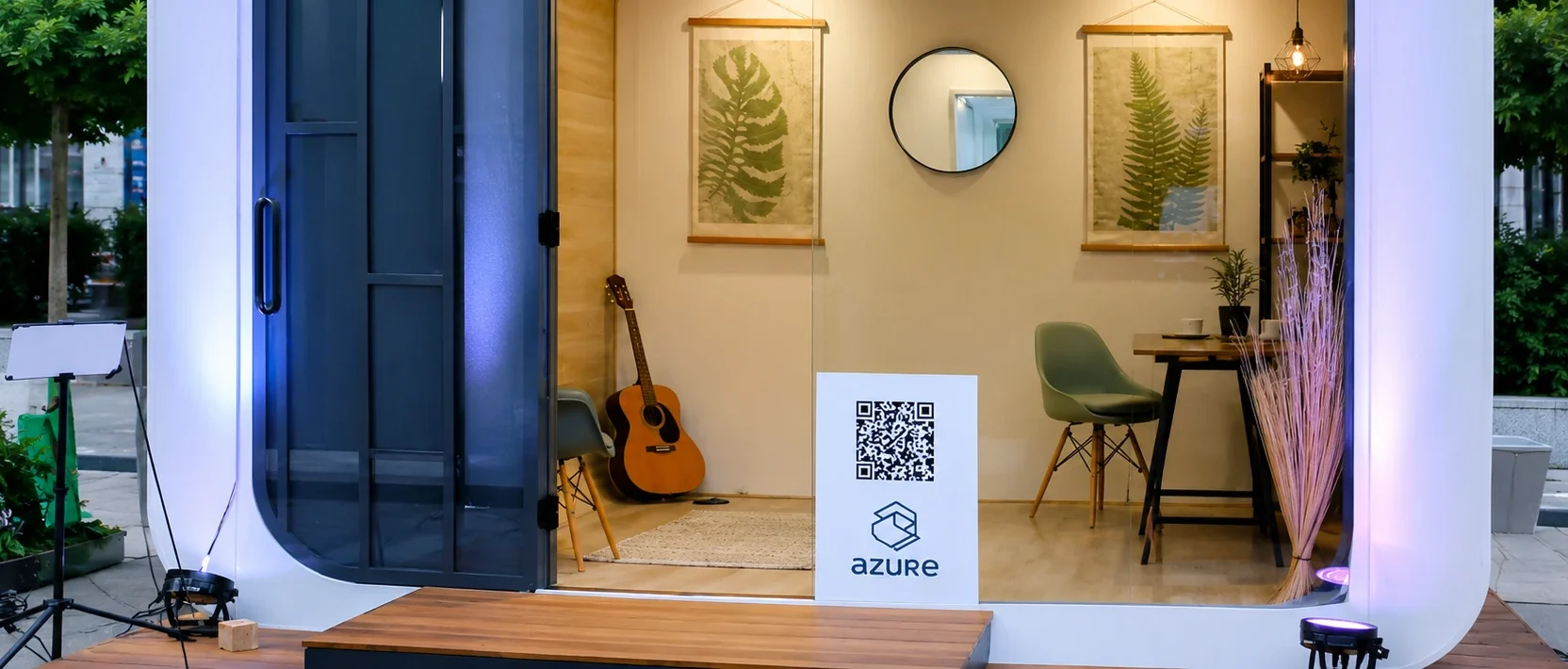
Our Homes on Wheels are built on an included chassis, so they need no foundation and can be moved when they are no longer needed:
- X-180: a studio with a bathroom and kitchen, from $69,900.
- X-270: one bedroom with a bathroom and kitchen, from $84,900.
- X-360: two bedrooms, a bathroom with a full-sized shower, a kitchen and a washer and dryer, from $109,900.
Our Homes on Wheels take one to three days to print and 10 to 15 days to finish inside, with a ready-to-ship notice at least four weeks after ordering. After the main house is rebuilt, the unit can become a guest house, a home office or a rental, subject to local zoning. If your insurance policy includes additional living expenses, ask your insurer whether it covers this type of temporary housing.

What Rebuilding With Azure Looks Like
For families rebuilding after the 2025 Los Angeles wildfires, we offer factory-built homes in Altadena and the Pacific Palisades. The process is organized into three phases:
- Design discovery: about four weeks to understand your needs and your lot.
- Design development: two to three months to complete the plans and submit them for approval.
- Fabrication and installation: two to four months after permit approval.
Pre-designed floor plans include the West, with 1,885 square feet, three bedrooms and 2.5 baths, and the Coastal, with 2,400 square feet, four bedrooms and 3.5 baths, and fully custom plans are also available. Pricing for these rebuilds includes the foundation, utilities and complete installation. Each family has one point of contact from design through move-in, and the homes are built to meet California building codes, the same standards as traditional construction.
Conclusion
If you need emergency housing, call 911 if you are in danger and 211 for local shelter and services. After a declared disaster, apply to FEMA and contact your insurer about additional living expenses. Then work with a caseworker or your local housing agency on rapid rehousing, vouchers or other programs that lead to stable housing.
For agencies and organizations that need to add emergency or interim housing quickly, contact us to discuss factory-built units for your community.