Tiny homes are shipped in one of two main ways: homes built on a foundation-ready base travel on a flatbed truck and are lifted into place on site, while tiny homes on wheels are built on their own chassis and towed to the property. In both cases, the cost depends mostly on distance, the size and weight of the unit, permits for wide loads and how easy the site is to reach.
Plan delivery before you order. A narrow gate, a steep driveway or soft ground can turn a simple drop-off into a much harder job.
The Main Ways Tiny Homes Are Shipped
| Method | Used for | How it works |
| Flatbed truck | Factory-built studios, tiny homes and modules | The unit is secured on a flatbed trailer, driven to the site and placed on its foundation with lifting equipment |
| Towing on its own chassis | Tiny homes on wheels and park models | The home is built on a trailer chassis and towed by a truck rated for its weight |
| Shipped as a kit | Kit and shell homes | Precut parts are delivered by truck and assembled on site |

Shipping a Tiny Home by Flatbed
Most factory-finished tiny homes and backyard studios travel on flatbed trucks. The unit is loaded at the factory, strapped down and driven to the property. At the site, a crane, forklift or other lifting equipment moves it onto the prepared foundation, depending on access and the size of the unit.
Weight matters too. At Azure Printed Homes, our 120-square-foot studios weigh about 6,000 pounds, so the delivery route and the final placement area need to handle that load.
Towing a Tiny Home on Wheels
A tiny home on wheels is built on a trailer chassis, so it can be towed to the site and moved again later. The towing vehicle must be rated for the home’s weight, and the driver needs to follow state rules for trailer size, lighting and brakes.
Our Homes on Wheels are built on an included chassis and certified at the factory as park models. The X-180, X-270 and X-360 are 9 feet wide and 20, 30 and 40 feet long. Because they are built on a chassis, they need no foundation, but local zoning still decides where they can be parked and whether they can be lived in full time.
Wide-Load Permits and Road Rules
Federal rules set a standard maximum vehicle width of 8.5 feet on the national highway network. Loads wider than that are generally treated as oversize and need permits from each state they pass through. Depending on the state and the size of the load, oversize moves can also require escort vehicles, warning signs and travel only during certain hours.
Professional transport companies usually handle these permits as part of the delivery. For you, that mostly means a higher bill and less flexible dates, since permits and escorts cost extra and some states restrict oversize loads on weekends and holidays.
How Much Tiny Home Shipping Costs
Shipping is usually priced by the mile, with extra charges for permits, escorts and any lifting equipment on site. At Azure, our delivery rates are:
| Unit type | Delivery rate | Example: 300 miles | Example: 1,000 miles |
| Studios and Homes on Wheels | $2.50 per mile | About $750 | About $2,500 |
| Homes & ADUs | $5 per mile | About $1,500 | About $5,000 |
We ship from our factory in Gardena, California, to anywhere in the continental U.S., Mexico and Canada using flatbed trucks. Delivery is priced separately from the home, along with site work, the foundation and permits.
How Long Delivery Takes
Production time comes before shipping. Our studios are printed in about a day and finished in roughly four more, and you receive a ready-to-ship notice at least two weeks after ordering. Our Homes on Wheels take one to three days to print and 10 to 15 days to finish inside, with a ready-to-ship notice at least four weeks after ordering. Depending on location, a backyard studio can be delivered within 30 to 60 days, and an ADU or home within 90 to 120 days.
Travel time itself depends on distance and on any permit restrictions for wide loads.
How to Prepare Your Site for Delivery
- Access route: check that the truck can reach the property, including turns, overhead wires, tree branches and low bridges along the way.
- Gates and driveways: measure gate widths and check the slope and surface of the driveway.
- Ground conditions: soft, wet or uneven ground may not support a loaded truck or lifting equipment.
- Foundation: have the foundation or pad ready before delivery. For our studios, a slab is not required, but a perimeter concrete or masonry foundation with hold-down bolts is recommended.
- Utilities: plan connections for power, and for water and sewer if the unit has a bathroom or kitchen.
- Permits: confirm local permits before the delivery date. Most municipalities don’t require a building permit for a structure of 120 square feet or less, but larger units usually need one.
Azure Models and How They Ship
| Model | Type | Dimensions | Starting price |
| N-100 | Backyard studio, flatbed delivery | 9 x 11 ft | $24,900 |
| A-120 / D-120 | Backyard studio, flatbed delivery | 9 x 13 ft | $29,900 |
| X-180 | Home on wheels with bath and kitchen | 9 x 20 ft | $69,900 |
| X-270 | Home on wheels, 1 bedroom | 9 x 30 ft | $84,900 |
| A-360 | Home or ADU on a foundation | 18 x 20 ft | $89,900 |
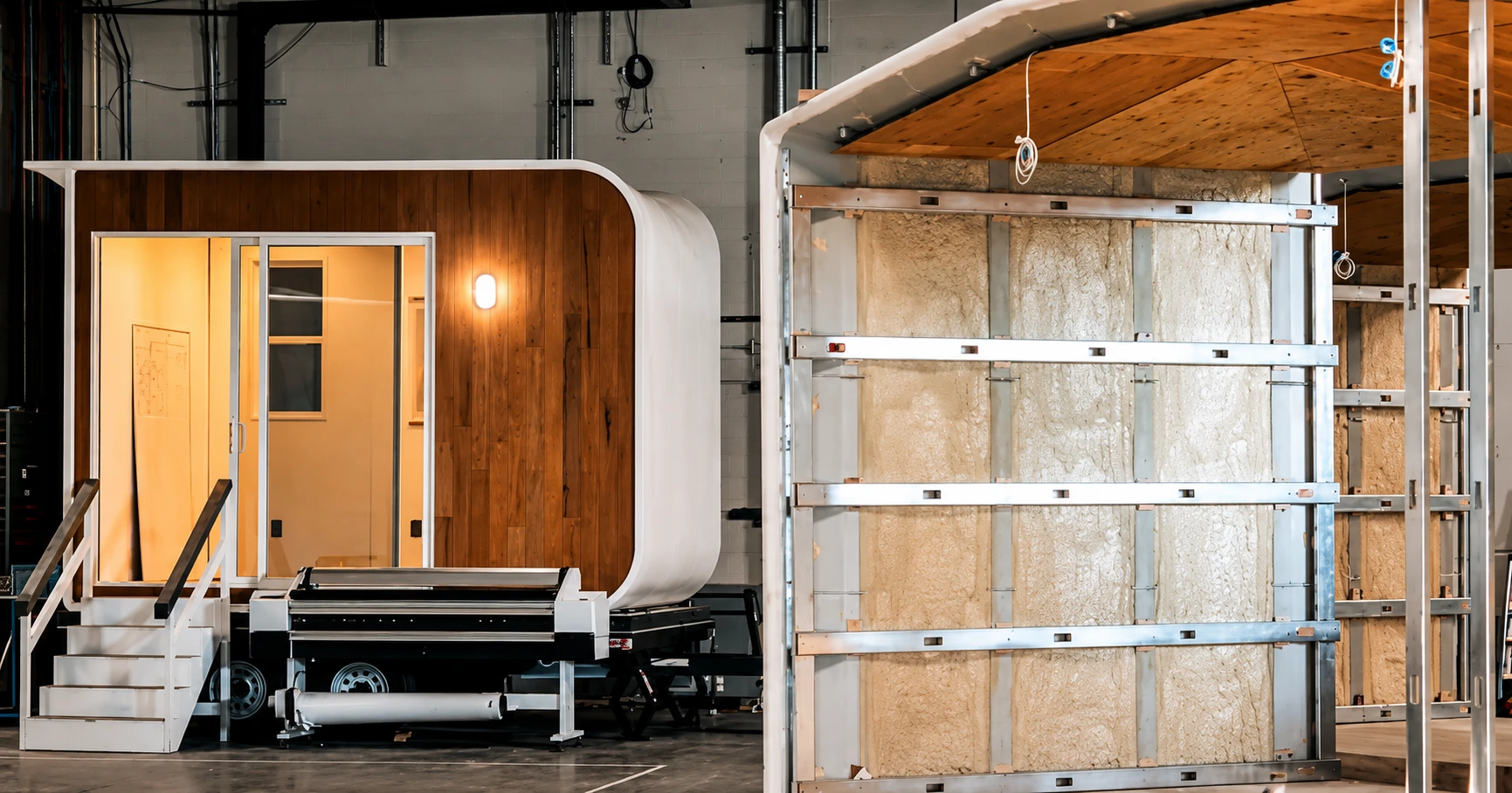
Our units are robotically printed from a material that is more than 60% recycled plastic and finished in our factory, including electrical work and standard finishes, so they arrive ready for placement and connection.
Can a Tiny Home Be Moved Again?
Tiny homes on wheels are designed to move. Factory-built homes on foundations can often be moved as well, but it takes more work. Our homes are bolted to the foundation and can be unbolted and transported to a new site if your plans change.
What Happens on Delivery Day
On delivery day, the truck arrives with the finished unit, and the crew places it on the prepared foundation or pad. For our homes, the modules are bolted and strapped together on the inside and sealed and flashed on the outside. Studios are secured to the foundation, and we recommend a perimeter concrete or masonry foundation with hold-down bolts.
After placement, the unit is connected to power, and to water and sewer if it has a bathroom or kitchen. The foundation and utility hookups are the owner’s job, so book your contractor for delivery day. Heating and cooling are an additional cost: smaller units usually use a ductless mini-split system, while larger homes use a central ducted system.
Because the electrical work and finishes are completed in our factory, there is far less work left to do on site than with a home built from scratch.
Ordering and Payment Before Shipping
Shipping is scheduled once the unit is built and paid for. You can configure a model online and reserve it with a fully refundable $250 deposit. For our backyard studios, payments are made in stages:
- First payment: 10% when your design configuration is complete.
- Second payment: 30% within 60 days of your studio’s manufacturing date.
- Third payment: 30% when a confirmation date for production is scheduled.
- Final balance: due 14 calendar days before the scheduled ship date.
Financing is also available through our partner, Acorn Finance. Line up the site work and foundation with the payment schedule, so the unit isn’t finished before the site is.
Conclusion
Tiny homes are shipped either on flatbed trucks and lifted onto a foundation, or towed on their own chassis. Costs depend on distance, size, wide-load permits and site access, and good preparation of the route, foundation and utilities keeps delivery day simple.
Our delivery rates are $2.50 per mile for studios and Homes on Wheels and $5 per mile for homes, with shipping available across the continental U.S., Mexico and Canada. Contact us to plan delivery to your property.